
Hybrid Car vs PHEV: Which One Is Actually Better for Indian Buyers in 2026?
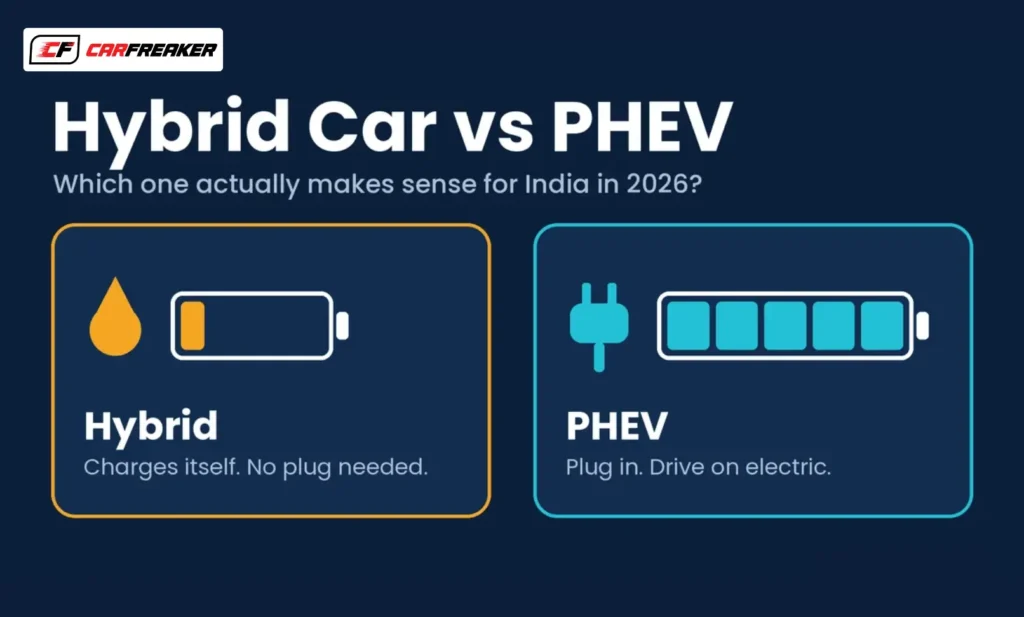
If you’re confused about hybrid car vs PHEV, tension mat lo, you’re not the only one. Until recently, PHEVs in India were only available at luxury-car prices, so this comparison didn’t even make sense. But with the MG Hector Tomahawk PHEV launching in August 2026 at ₹25.69 lakh, ab ek normal family bhi regular hybrid car vs PHEV ko seriously compare kar sakti hai. So let’s break it down the Carfreaker way: no jargon, bas seedhi baat about your wallet and your daily drive. What Is the Difference Between a Hybrid Car and a PHEV? Let’s keep it simple. A regular (strong) hybrid has a petrol engine, an electric motor and a small battery. The battery charges by itself through braking and the engine, so you never plug it in. Bas petrol dalo aur chalo. The Maruti Grand Vitara, Maruti Victoris, Toyota Hyryder and Toyota Innova Hycross all work this way. A PHEV (plug-in hybrid) has a much bigger battery that you charge from a wall socket, just like an EV. It can run on pure electric power for a good distance, and when the battery runs low, petrol engine takes over. On paper, yeh dono duniya ka maza hai. So the core hybrid car vs PHEV difference is this: one never needs a plug, the other gives full benefit only when you charge it regularly. (Quick note: a “mild hybrid” is not the same thing. It only gives the engine a small assist and can’t run on electric power alone. In this article, “hybrid” means strong hybrid.) Hybrid Car vs PHEV: Quick Comparison Table Feature Regular Strong Hybrid PHEV Needs plug-in charging? No Yes (for full benefit) Battery size Small (self-charging) Large (20.5 kWh in MG Hector Tomahawk) Pure electric range Few km at low speeds Claimed ~115 km (MIDC) on Tomahawk PHEV Claimed combined range ~900 to 1,000 km per tank Claimed ~1,100 km Price in India (2026) Around ₹20 – 25 lakh onwards (hybrid variants cost more) ₹25.69 – 27.79 lakh ex-showroom (Tomahawk) Models available Grand Vitara, Victoris, Hyryder, Hycross, City e:HEV MG Hector Tomahawk PHEV (only mass-market option) Regular Hybrid Car: The “Bas Chalti Hai” Option This is the practical choice. No charger, no wallbox, no planning. You fill petrol and enjoy better mileage than a normal petrol car. The numbers: The Grand Vitara and Hyryder strong hybrids are rated at 27.97 kmpl, and the Victoris strong hybrid at 28.65 kmpl. But real life thodi alag hoti hai. In Autocar India’s test cycle, the Grand Vitara strong hybrid returned around 23.77 kmpl in the city and 20.39 kmpl on the highway, which is still very good for a mid-size SUV. Spinny’s data also shows that city mileage can vary by up to 4 kmpl depending on your driving style and traffic. What owners are actually saying: One Grand Vitara strong hybrid owner on Autocar India’s advice forum said they’re extremely happy with their mileage, getting around 900–1,000 km from a 45-litre tank. Ek dikkat zaroor boli though: after switching from a diesel car, they feel they’ve lost some joy of driving, because the performance is relaxed rather than exciting. On the other hand, one CarWale reviewer wasn’t impressed, pointing to noisy engine behaviour and mileage below expectations. Autocar India also notes that boot space takes a hit in strong hybrid versions because of the battery placement. Service and running cost: Maruti and Toyota both have huge service networks, so workshop kabhi door nahi hota. Hybrid maintenance is close to a petrol car’s, and since the battery is self-charging, there’s no extra cost of installing a charger. The real question: Is the extra money worth it? An Autocar India reader recently asked exactly this. They drive only about 20–22 km a day in heavy traffic and were considering a hybrid that costs ₹7–8 lakh more than a regular petrol sedan. Yeh ek honest dilemma hai. If your daily running is low, recovering that premium through fuel savings can take years. Best for: Buyers who can’t or don’t want to install a charger, drive mostly in city traffic, and want better mileage without changing their habits. PHEV: The “Part-Time EV” Option A PHEV is a clever idea. Charge it at home overnight, and your daily 30–40 km commute can run on electricity alone. Long trip par jaana hai? The petrol engine takes over, so zero range anxiety. The big news for India: The MG Hector Tomahawk PHEV is currently the only mass-market PHEV on sale. It pairs a 1.5-litre petrol engine with a 20.5 kWh battery and a single electric motor, with a claimed 115 km of electric-only range and about 1,100 km combined range. It’s a seven-seater priced from ₹25.69 lakh ex-showroom. There’s also a Battery-as-a-Service (BaaS) option that brings the upfront price down to ₹21.79 lakh, lekin monthly battery rental alag se dena padta hai. Honest warning: At the time of writing, test drives and deliveries are only starting in November 2026. Matlab real-world range ya service cost par abhi koi long-term owner feedback available nahi hai, and we won’t pretend otherwise. The claimed range is based on the MIDC test cycle, which is always more optimistic than daily driving. Treat 115 km as the best case, guarantee nahi. Once real Tomahawk PHEV owners start posting reviews on CarDekho, CarWale and Team-BHP, we’ll update this section with actual feedback. Service and running cost: MG’s service network is smaller than Maruti’s or Toyota’s, so check how close the nearest MG workshop is to you. PHEVs also have two powertrains (a petrol engine plus a big battery and motor), so long-term maintenance cost is something to watch. Best for: Buyers with a dedicated parking spot and home charging, short daily drives, and occasional long trips. Hybrid Car vs PHEV: Which Is Cheaper to Run? It depends on one thing: kya aap ghar par charge kar sakte ho? So, Hybrid Car vs PHEV: Which One Should You Buy? Hamari honest raay? For most Indian buyers in 2026, a