Should You Hold Off Buying a New Car or Bike Right Now? Here’s the Honest Carfreaker Take
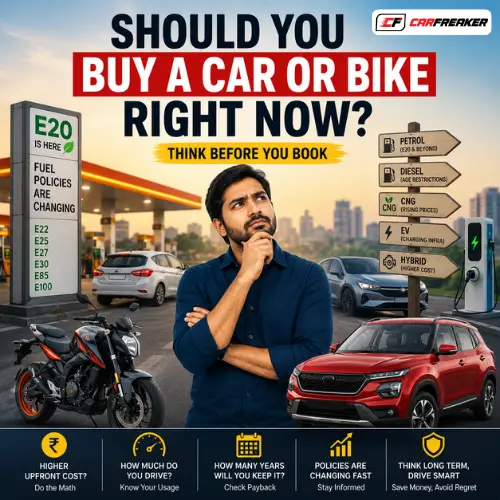
Every second day someone messages us on the consultant form asking the same thing – “bhai which car should I buy” or “is this bike worth it.” And most of the time we jump straight to comparing features, mileage, price. But lately we’ve been sitting on a bigger question that honestly nobody is talking about enough: should you even be buying right now?
We know how that sounds coming from an auto site. Usually we’re the guys pushing you toward a showroom. But this time we genuinely think a lot of buyers – especially middle class families here in Gujarat and across India – need to slow down for a bit and actually understand what’s happening with fuel and vehicle policy before they sign that booking form. Not because we don’t want you to buy a vehicle, but because we want you to buy the right one, at the right time, without regretting it two years down the line.
Here’s why.
Petrol Isn’t What It Used to Be, and Nobody Really Knows What’s Next
If you’ve filled petrol recently you’ve probably noticed it’s all E20 now – that’s petrol mixed with 20% ethanol. India hit this target in 2025, years ahead of schedule, and by April 2026 it became the standard at pumps across the country, not just in a few states.
Now on paper this sounds fine – cleaner fuel, less crude import dependency, more support for farmers growing sugarcane and maize. All good things. But here’s the part that doesn’t get talked about enough: the government’s own roadmap only commits to E20 till October 31, 2026. What happens after that is still under review. There’s already a committee report pending, standards have been notified for even higher blends like E22, E25, E27 and E30, and there’s serious talk about E85 and E100 flex-fuel vehicles too.
So basically, if you buy a regular petrol vehicle today, you genuinely don’t know what blend you’ll be filling into that tank two or three years from now. Older engines not built for higher ethanol content can see real issues – reduced mileage, corrosion in fuel lines, rubber components wearing out faster. Some owners have already been vocal about this, enough that it reached the Supreme Court and the ministry had to put out clarifications. That tells you it’s not a small, made-up concern.
Point is – the fuel your vehicle runs on isn’t fixed anymore. It’s a moving target, and moving targets are risky when you’re taking a 5-7 year loan on a vehicle.
Diesel Has Its Own Expiry Date, Literally
If diesel is on your mind, especially for an SUV, there’s something you need to know before you commit lakhs of rupees. In Delhi-NCR, diesel vehicles older than 10 years and petrol vehicles older than 15 years have effectively been getting cut off from fuel stations under CAQM orders, and this whole issue has been going back and forth in the Supreme Court through 2025 and into 2026. Right now there’s some relief for existing owners, but the direction is pretty clear – cities are actively working to phase out older diesel vehicles, and other major metros are watching Delhi’s playbook closely.
What this means practically – if you buy a diesel car today thinking you’ll run it for 12-15 years like people used to, that plan might not hold up, at least not in bigger cities. You could be looking at a vehicle that becomes unusable or worth very little well before you’ve finished paying it off, let alone gotten your money’s worth from it.
EVs Sound Great, Until You’re Actually Charging One Outside a Metro
We’re not against EVs, in fact we’ve covered quite a few – the e-Vitara, the BE.6E, Harrier EV – and the technology itself is genuinely impressive now. But let’s be real about infrastructure. Outside Ahmedabad, Surat, Vadodara and a handful of big cities, finding a working, fast public charger is still a gamble. Highway charging on long routes is improving but still patchy. If your daily use is strictly within city limits and you have space for home charging, sure, an EV can work beautifully. But if you’re someone who does long weekend drives to native place or travels between cities often, you need to go in with eyes open, not just because the showroom guy showed you a nice range number on a brochure.
CNG Isn’t the “Cheap Fuel” It Used to Be Either
A lot of buyers switch to CNG purely for the running cost. Fair enough, it used to be a big gap compared to petrol. But if you check the numbers, CNG rates have been climbing steadily over the last year in most cities – Delhi, Mumbai, Bangalore, Chennai, Kolkata have all seen hikes through 2025 into 2026, some cities more sharply than others depending on local taxes and gas allocation. It’s still cheaper than petrol per km, no doubt, but the gap that made CNG a no-brainer a few years back has been shrinking, and that changes your payback math on the extra cost of the CNG kit or variant.
The Upfront Price Gap Nobody Explains Properly
Here’s something we tell every single person who fills our consultant form, and honestly it deserves its own section because most showroom salespeople gloss over it.
Take any popular hatchback or compact SUV and check the petrol variant price. Now check the CNG variant of the exact same car. In the current market that gap is close to ₹1 lakh, sometimes a little less, sometimes a little more depending on the model. That’s money you’re paying upfront, on day one, before you’ve driven a single kilometre. Now the whole logic of going CNG is that you recover this extra lakh through cheaper running cost. And that math does work – but only if your usage is genuinely high. If you’re doing decent daily kilometres, you can claw back that ₹1 lakh in about 2-3 years. But if your car mostly sits in society parking and does short school-run type trips, that recovery period stretches out a lot longer, and suddenly the CNG variant isn’t the smart choice everyone assumes it is.
Now compare the same base petrol variant with its diesel version. That gap is usually bigger – somewhere around ₹1.5 to 2 lakh more upfront. Diesel used to make sense when you were doing serious highway running every month. But between diesel’s own cost premium, the age-restriction issues we talked about earlier, and the fact that most family cars today aren’t doing 2,000+ km a month, that extra 1.5-2 lakh takes a lot longer to justify than it used to.
And then there’s hybrid. This is where the gap gets genuinely large – we’re talking 2-3 lakh rupees more than the equivalent petrol variant, sometimes even higher depending on the model and trim. Yes, hybrids give you excellent mileage and lower running cost, no argument there. But you have to be honest with yourself about whether your driving pattern and years of ownership will actually let you recover 2-3 lakh rupees before you sell the car or upgrade again.
We’re not saying CNG, diesel or hybrid are bad choices. We’re saying – do the actual math for your own driving pattern before you pay that premium. Because for the average Indian buyer, this is hard earned money, and every extra lakh you pay upfront needs to come back to you in real savings, not just sound good on a brochure. Ask yourself honestly – how many kilometres do I actually drive in a month, and how many years am I realistically going to keep this vehicle – before you decide the higher variant is “worth it.”
The Real Point – It’s Not Just the On-Road Price
Here’s the thing we really want every reader to sit with. When you buy a vehicle, the sticker price is honestly the easy part. What actually hits your monthly budget is the combination – EMI, insurance premium, fuel cost that keeps shifting depending on policy, and service costs that only go up as the vehicle ages. For a lot of Indian middle class households, this is hard earned money we’re talking about, not something to gamble on unclear fuel and emission policies.
So our honest advice, and we don’t say this lightly, is – if your current vehicle is still running fine, it might genuinely make sense to hold off for a few more months. Let the E20-and-beyond roadmap become clearer post October 2026. Let more cities show their hand on diesel age rules. Let EV charging infrastructure catch up a bit more outside the metros. A rushed purchase today could mean adjusting to a completely different reality by 2027.
If your vehicle absolutely needs replacing, or you’re a first time buyer who can’t really wait, that’s a different conversation – and one we’re happy to have with you directly. That’s exactly what our free Car & Bike Consultant service is for. Tell us your budget, your usage pattern, how much you drive daily, whether you have charging access, and we’ll walk you through what actually makes sense for your situation right now, not just what’s trending.
At the end of the day our job at Carfreaker isn’t to push you into a showroom. It’s to make sure when you do walk in, you’re walking in with your eyes open.
– Team Carfreaker